Launch offer — valid today only

📄 Digital book in PDF · read it on your phone or print it

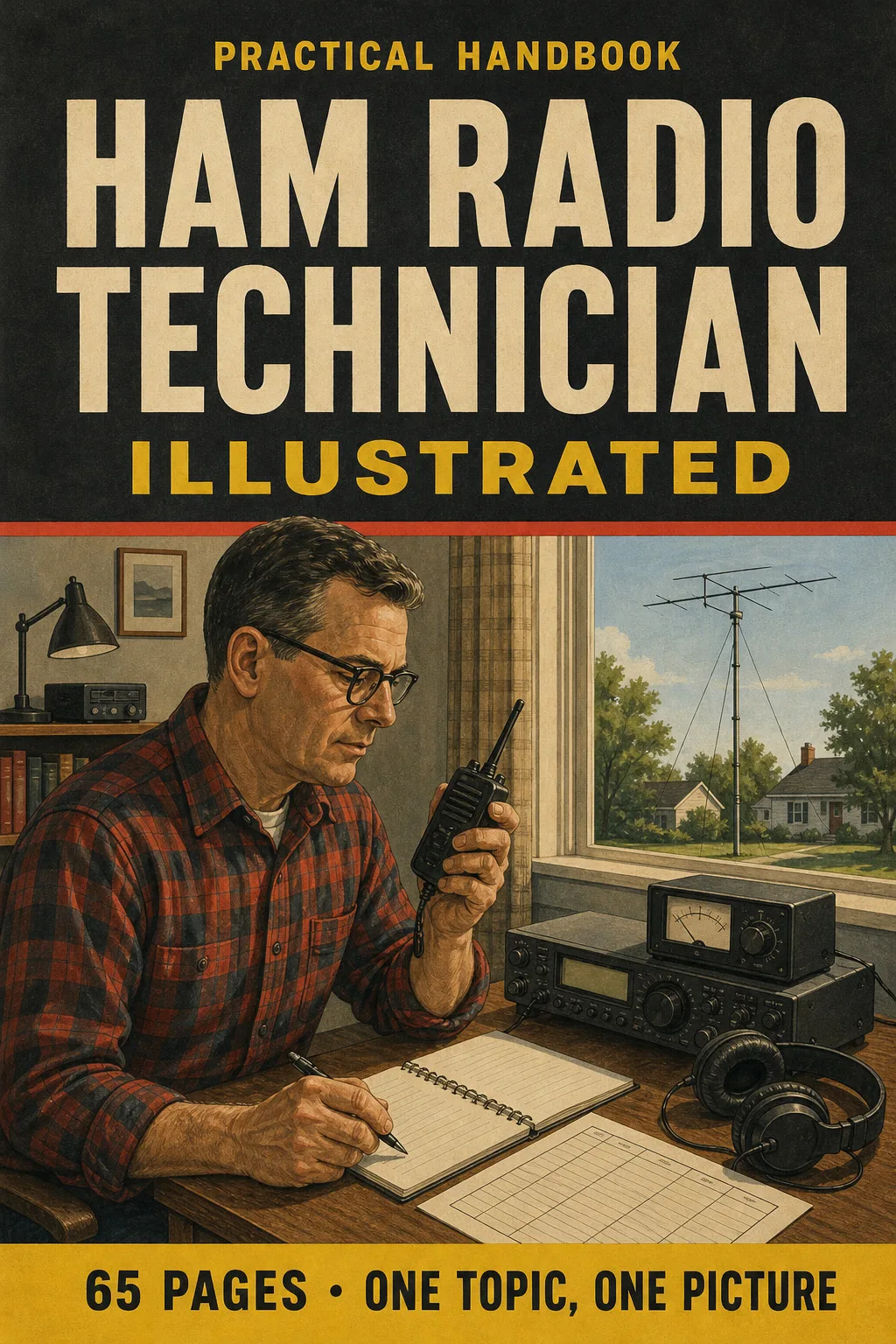
The Ham Radio Technician Exam in Drawings Bands, Rules and Formulas You Can Read at a Glance

Band privileges, station ID rules, MHz and meters, Ohm's law, the half-wave dipole, repeaters, propagation and RF safety. Every topic has its own page: first the drawing, then what you need to remember. 65 illustrated pages.

START STUDYING THIS WAY

🔒 Secure checkout · PDF by email · 30-day guarantee

Every topic, its own pageEvery rule and formula drawn, with the explanation right beside it
65 illustrated pages8 parts, from what your license lets you do to the exam-week checklist
Up-to-date sourcesFCC Part 97 rules and the 2026-2030 Technician question pool
PDF by emailFormat

Look Inside the Book

Every page has one big drawing and a box with the numbers and rules you need to know:

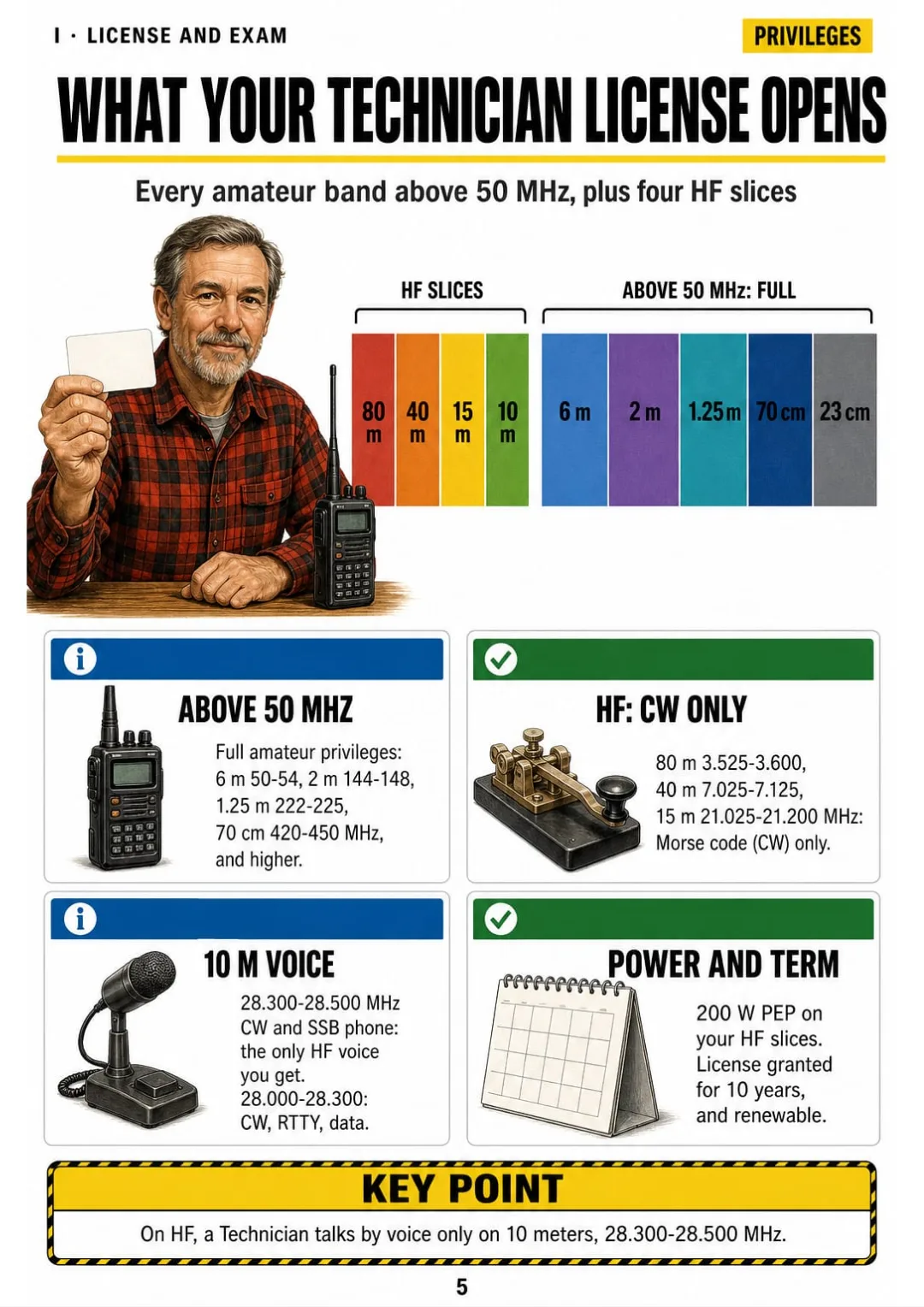
Full privileges above 50 MHz, CW on 80/40/15 m, voice on 10 m 28.300-28.500 MHz.
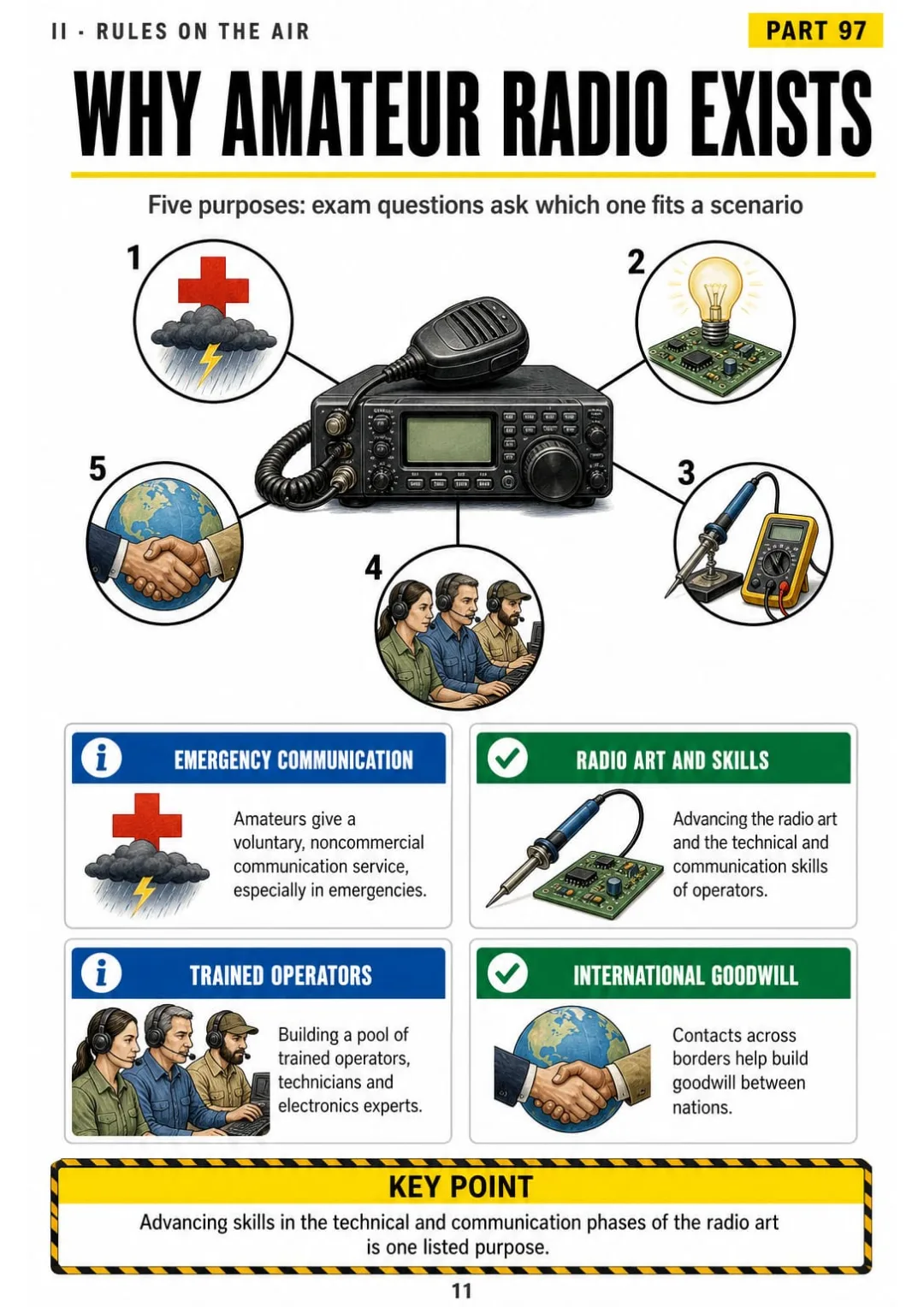
The 5 purposes of amateur radio in Part 97, drawn around one radio
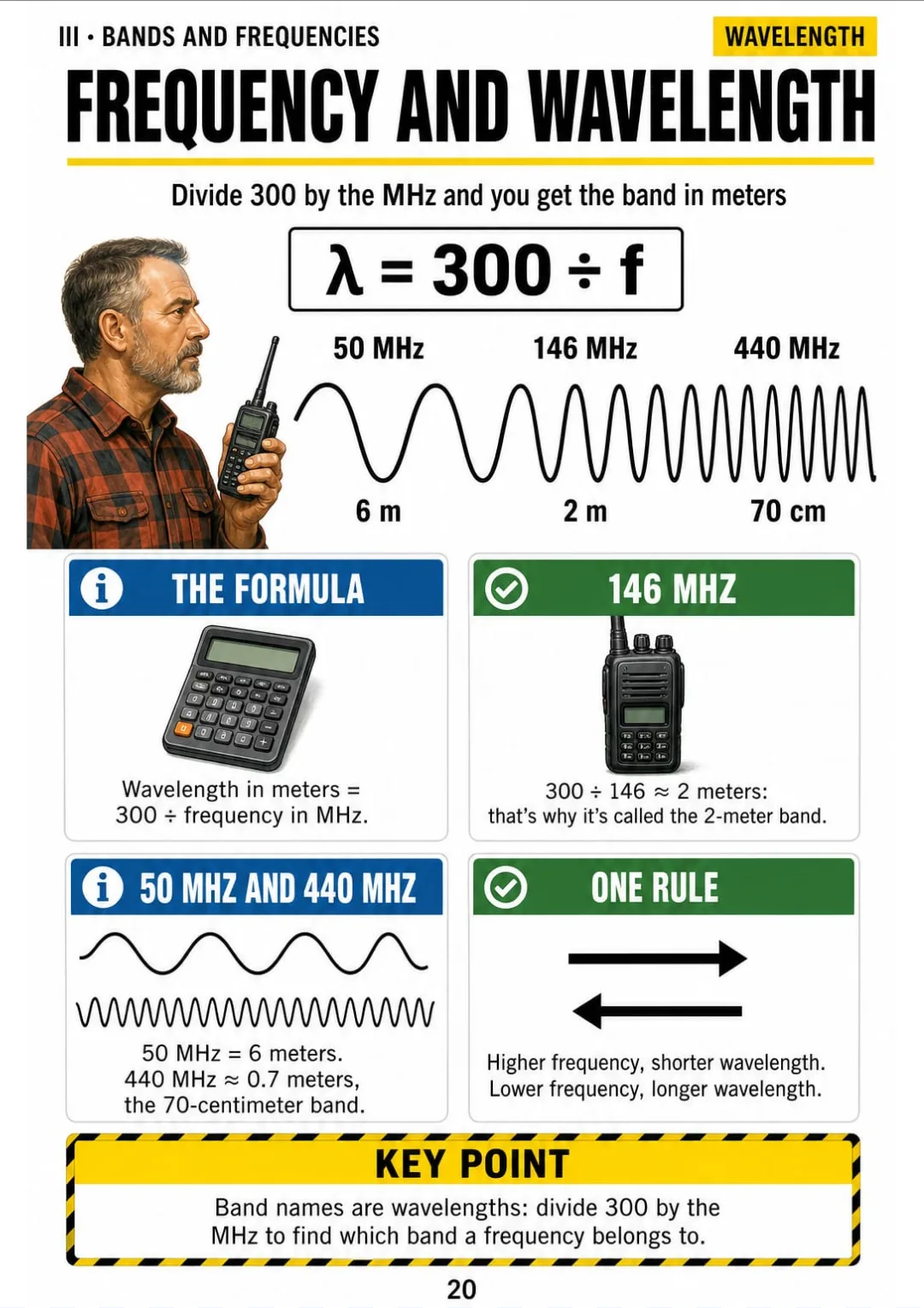
Wavelength (m) = 300 ÷ MHz: 146 MHz ≈ 2 m, 50 MHz = 6 m, 440 MHz ≈ 70 cm.
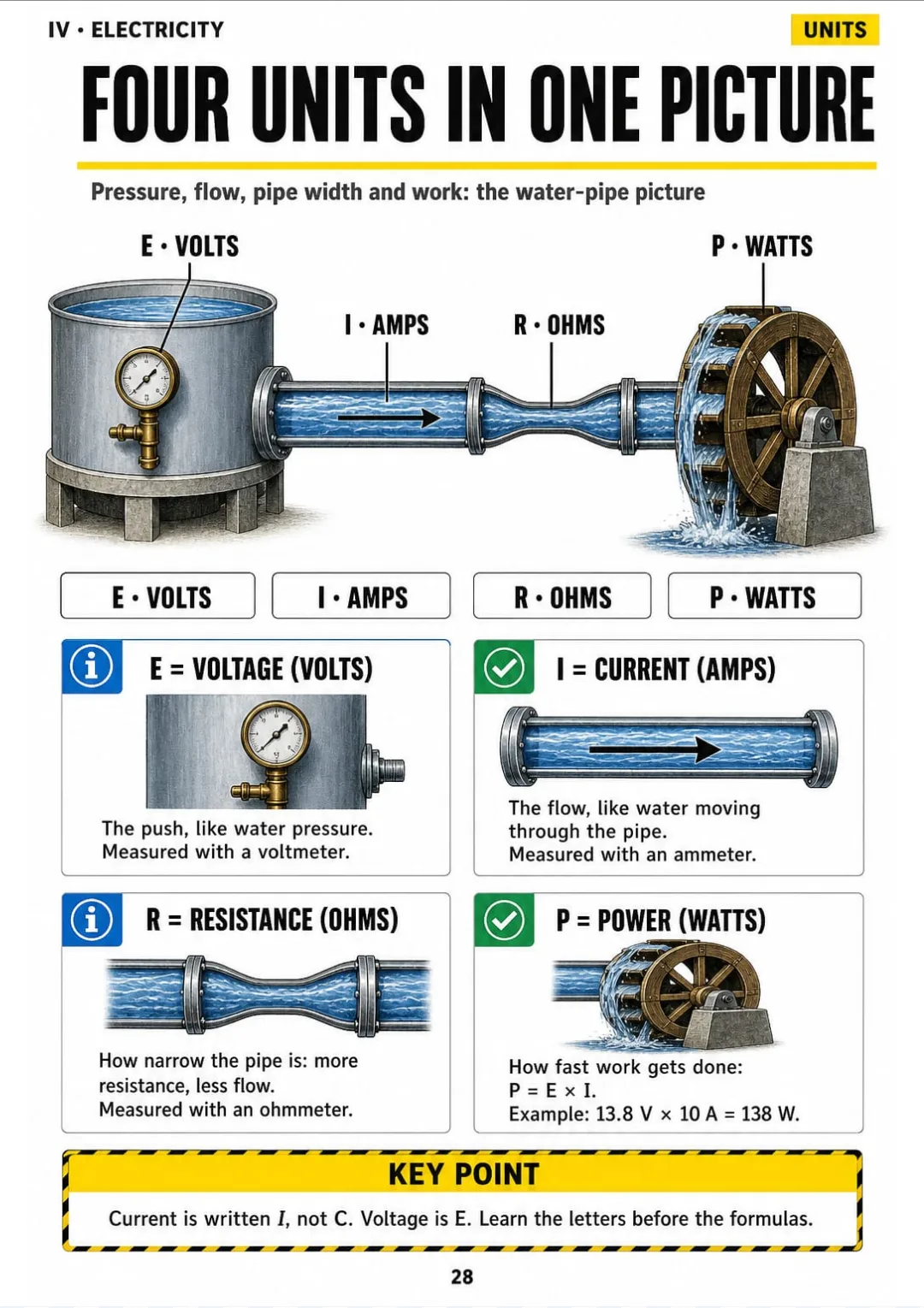
E is pressure, I is flow, R is the narrow pipe, P is how fast work gets done.
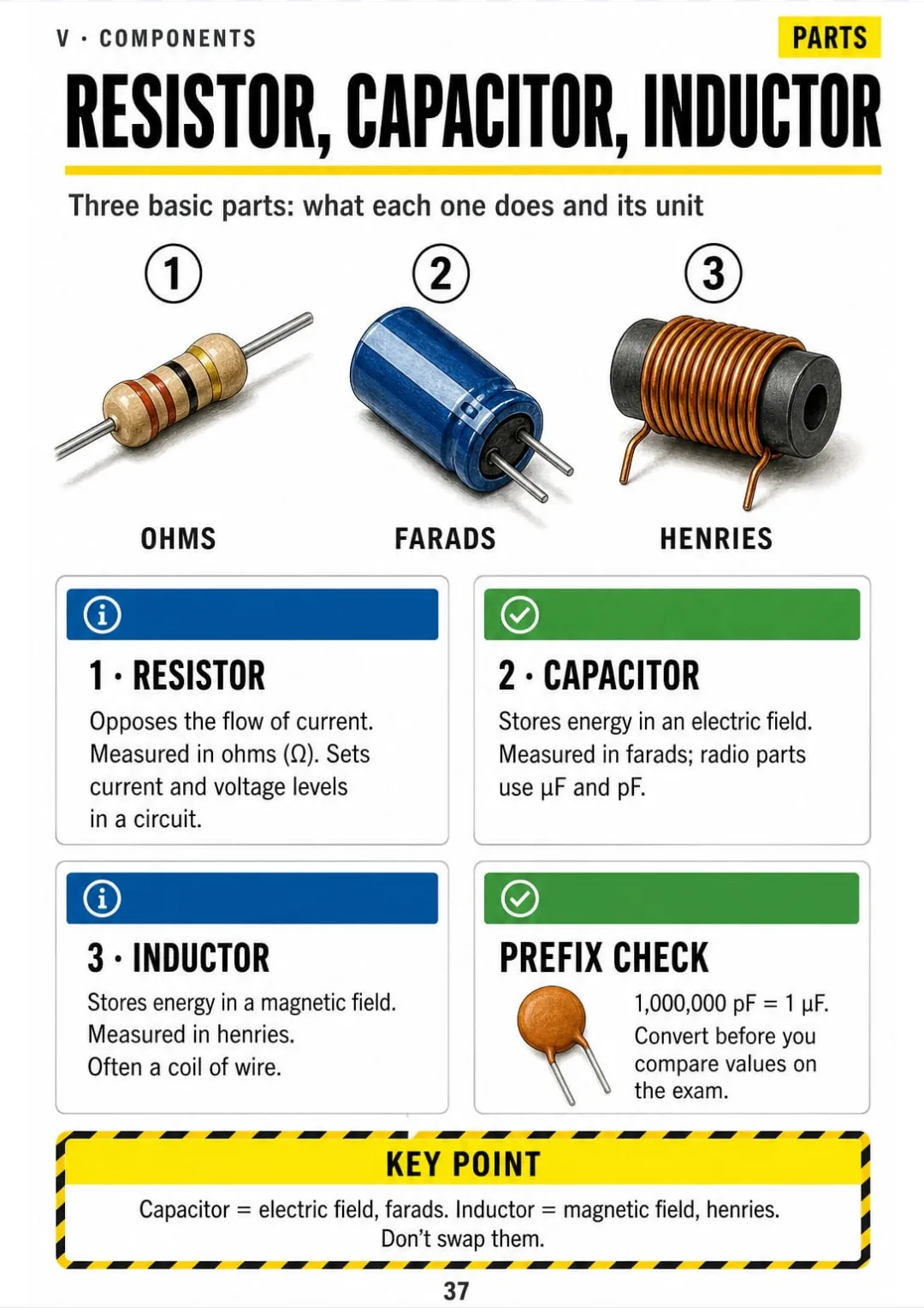
Resistor in ohms, capacitor in farads, inductor in henries: one drawing each
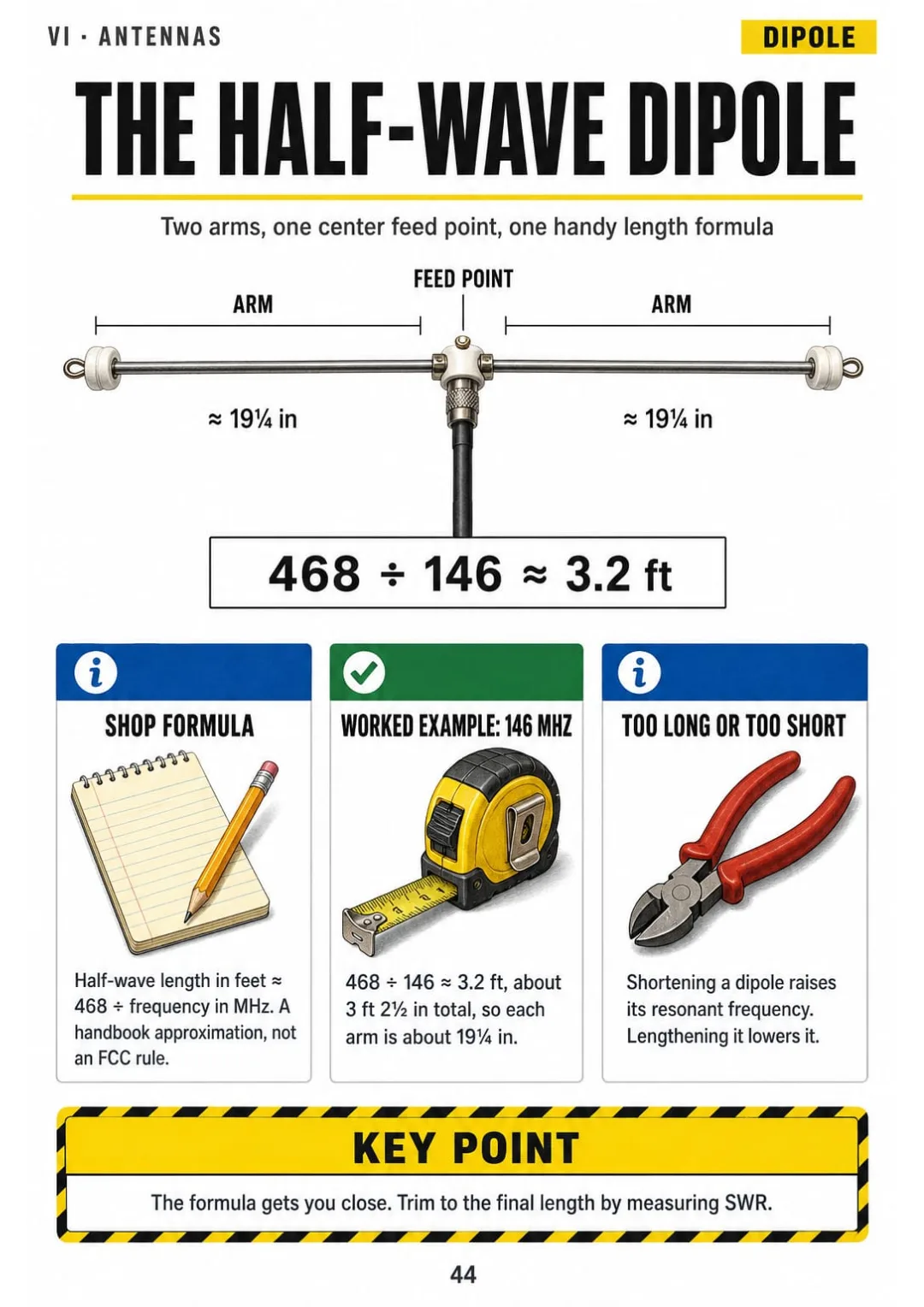
Half-wave dipole at 146 MHz: about 3 ft 2½ in, each arm about 19¼ in.
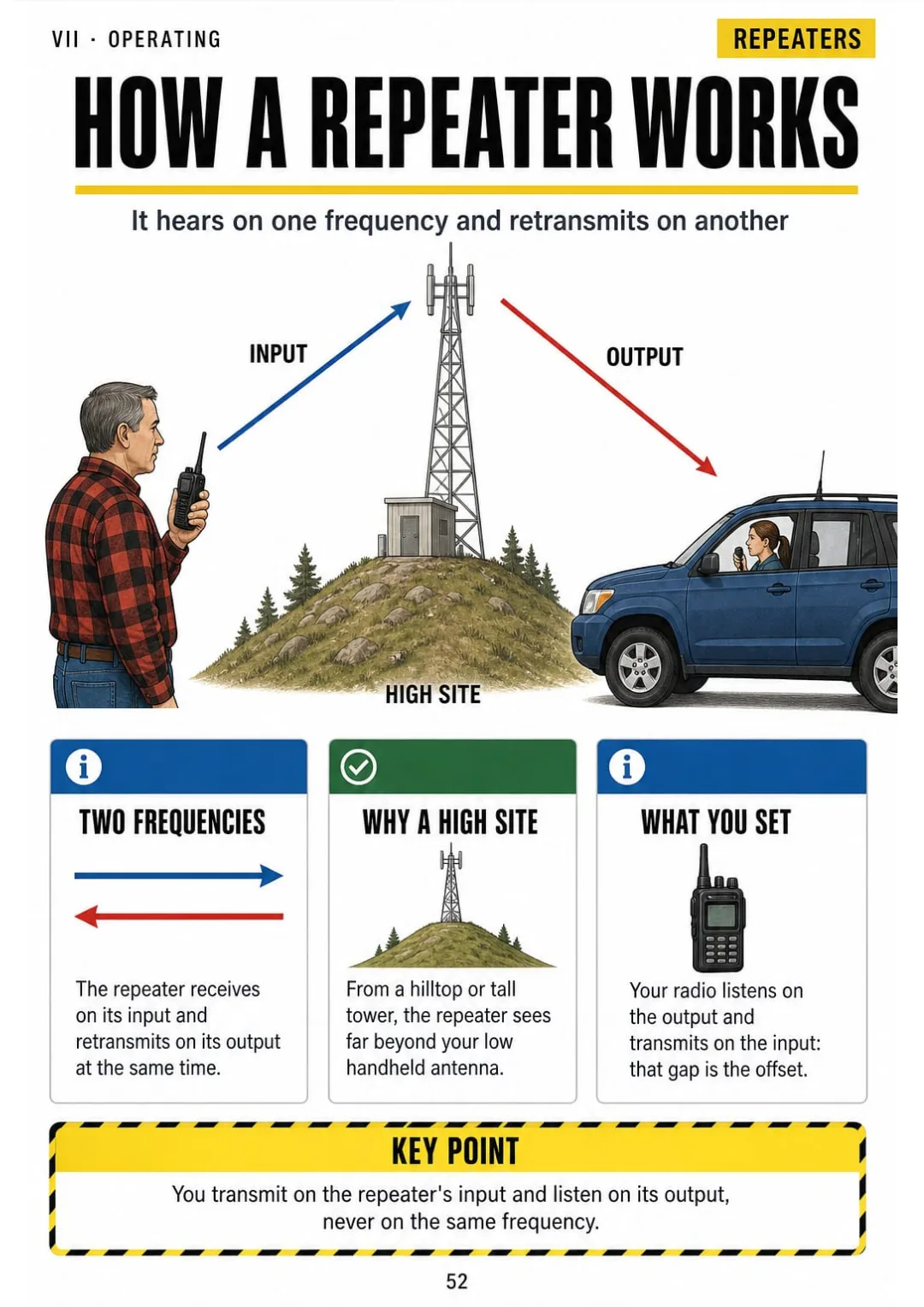
Repeater: you transmit on the input, everyone hears you on the output from a high site.
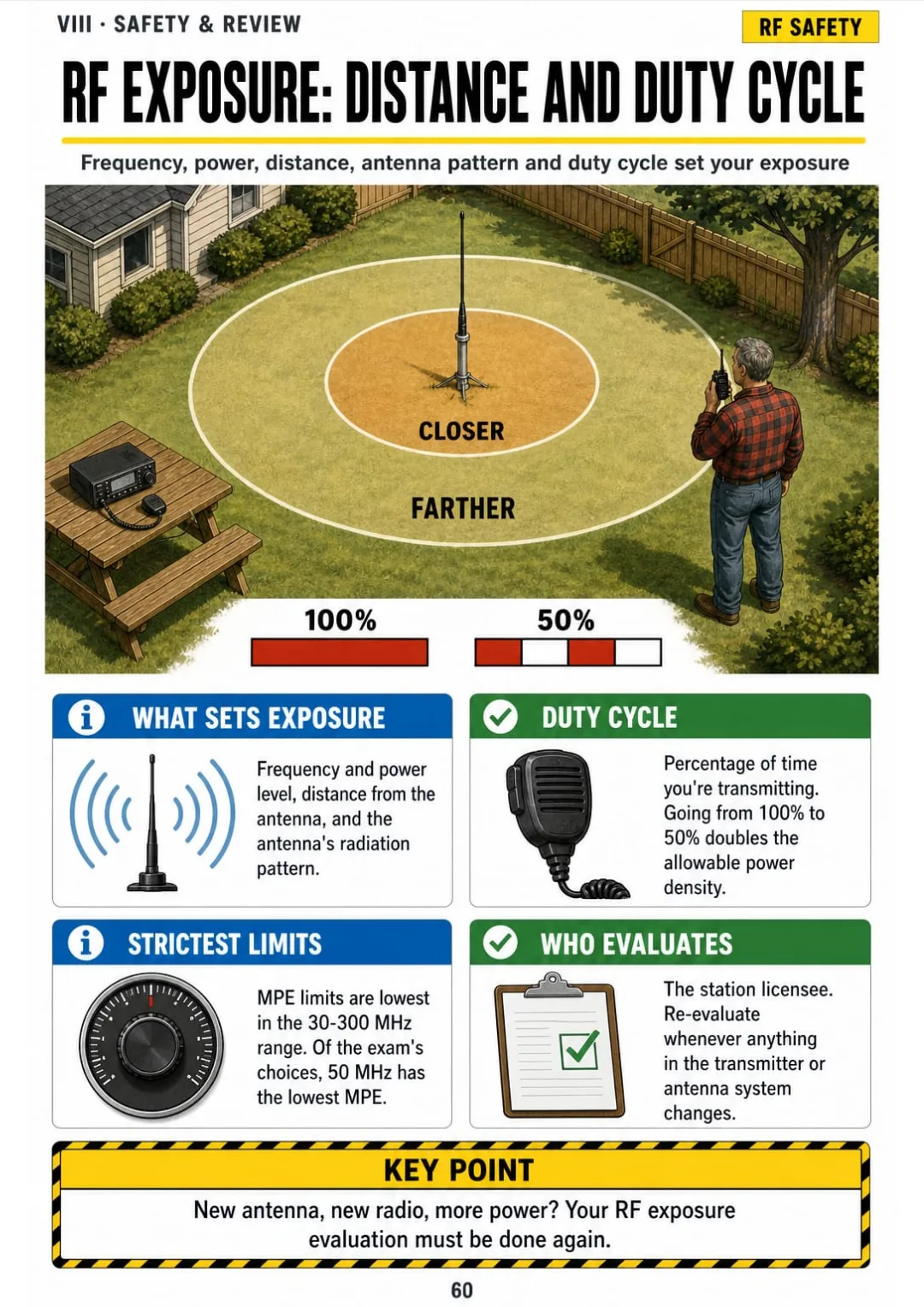
RF exposure: 100% → 50% duty cycle doubles allowable power density; 30-300 MHz is strictest

Swipe to see more →

These are real pages from the book. The table of contents is the full one: 8 parts and 61 topics.

The Problem Isn't You. It's How It Was Explained to You.

You're looking at a question about 146.520 MHz, and all four answers are in meters. MHz on one side, meters on the other, and nothing connecting them.

The manual covers it in two dense paragraphs about the speed of light, cycles per second and scientific notation. You read it, you nod, and by the next day it's gone.

Wavelength (m) = 300 ÷ MHz: 146 MHz ≈ 2 m, 50 MHz = 6 m, 440 MHz ≈ 70 cm.

In the book, that same topic is one page: a wave drawn across it with MHz and meters side by side, and one box: wavelength in meters = 300 ÷ MHz. 146 MHz is about 2 meters, 50 MHz is 6, 440 MHz is about 70 centimeters.

The rest of the exam works the same way. Band privileges, Ohm's law, the half-wave dipole, repeater offset and RF exposure each get their own page.

When the band question comes up, you divide 300 by the number and you're done. You get it, and you answer without going back to the manual.

COMPARE FOR YOURSELF

Same Topic, Two Ways to Study It

THIS
  • The manual: line after line after line
  • MHz to meters explained with the speed of light
  • You walk into the exam session still unsure
A repeater is a station, usually installed at an elevated location, that receives signals on one frequency and simultaneously retransmits them on another. The difference between the two, known as the offset, is standardized by band: on 2 meters it is generally 600 kHz, on 70 centimeters 5 MHz. In addition, many repeaters require the transmitting station to send a continuous subaudible tone (CTCSS) in order to access the system.
FOR THIS
  • One wave drawn, MHz and meters side by side
  • The key points in one box
  • You see it and it makes sense
The 5 purposes of amateur radio in Part 97, drawn around one radio
CONTENTS

Take a Look at the 8 Parts and 61 Topics

The license and the exam, rules on the air, bands and frequencies, electricity and Ohm's law, components and your station, antennas and feed lines, operating and repeaters, and safety with a final review: 65 pages, all illustrated.

IThe License and the Exam · pp. 5-10
  1. What the Technician License Lets You Do
  2. How the Exam Works
  3. The Volunteer Examiner Session
  4. Your FRN and Your First Call Sign
  5. License Term, Renewal and Grace Period
  6. How to Use This Book
IIRules on the Air · pp. 11-19
  1. The Purpose of Amateur Radio
  2. Identifying Your Station: Every 10 Minutes
  3. The Control Operator
  4. What You Can't Transmit
  5. Communicating With Other Countries
  6. Interference and Who Has Priority
  7. Emergencies: When the Rules Bend
  8. Reciprocal Operating and Licensing Details
  9. Beacons, Space Stations and Third-Party Rules
IIIBands and Frequencies · pp. 20-27
  1. Frequency and Wavelength Are Two Sides of One Wave
  2. Metric Prefixes Without Panic
  3. The Spectrum Map: HF, VHF, UHF
  4. The 2-Meter Band: 144-148 MHz
  5. 70 Centimeters and 1.25 Meters
  6. 6 Meters: 50-54 MHz
  7. Your HF Slices: 10, 15, 40 and 80 Meters
  8. Staying Inside the Band Edge
IVElectricity and Ohm's Law · pp. 28-36
  1. Volts, Amps, Ohms and Watts in One Picture
  2. The Ohm's Law Triangle
  3. Ohm's Law: Three Exam-Style Examples
  4. The Power Formula: P = E × I
  5. AC vs. DC
  6. Series and Parallel Circuits
  7. Decibels: 3, 6 and 10
  8. Conductors, Insulators and Short Circuits
  9. Using a Multimeter
VComponents and Your Station · pp. 37-43
  1. Resistors, Capacitors and Inductors
  2. Diodes, Transistors and Switches
  3. Reading a Schematic
  4. The Basic Station Block Diagram
  5. Power Supplies and Batteries
  6. Transceivers and Their Controls
  7. RF Interference and How to Fix It
VIAntennas and Feed Lines · pp. 44-51
  1. The Half-Wave Dipole
  2. The Quarter-Wave Vertical
  3. Directional Antennas: the Yagi
  4. Polarization: Vertical vs. Horizontal
  5. The Rubber Duck and Why It Underperforms
  6. Coax and Connectors
  7. SWR: What the Meter Is Telling You
  8. Antenna Tuners and Matching
VIIOperating, Repeaters and Propagation · pp. 52-59
  1. How a Repeater Works
  2. Offset and Tone: Programming Your Handheld
  3. Your First Repeater Contact
  4. Simplex, Calling Frequencies and Band Plans
  5. Phonetics, Q Signals and RST
  6. Modes: FM, SSB, CW and Digital
  7. Satellites: Uplink, Downlink and Doppler
  8. Propagation: Line of Sight, Ducting and Sporadic E
VIIISafety and Final Review · pp. 60-65
  1. RF Exposure: Distance and Duty Cycle
  2. Electrical Safety and Grounding
  3. Towers, Antennas and Lightning
  4. The Mix-Ups That Trip People Up Most Often
  5. Every Formula on One Page
  6. Exam-Week Checklist

One Page, One Topic, All Clear

Think of it this way:

You've passed, your call sign is in the database, and you want to talk on the local repeater for the first time. Frequency, offset, tone: you need all three right, or nobody hears you.

In the book you open the repeater page and it's all drawn: your handheld transmitting on the input, the repeater up on a high site, everyone hearing you on the output, with the offset and the tone marked step by step.

Resistor in ohms, capacitor in farads, inductor in henries: one drawing each

Same with the band chart, the Ohm's law triangle, the dipole in feet and inches, and duty cycle for RF exposure: each one on its own page.

Ham Radio Technician Illustrated is 65 illustrated pages in 8 parts, one topic per page, with every formula on one page and an exam-week checklist at the end.

What you see drawn, you don't have to memorize.

What's Inside Ham Radio Technician Illustrated:

Ipp. 5-10

The License and the Exam

What the Technician license lets you do, how the 35-question exam and the volunteer examiner session work, your FRN, your first call sign and renewal.

IIpp. 11-19

Rules on the Air

Why amateur radio exists, station ID every 10 minutes, the control operator, what you can't transmit, interference, emergencies and third-party rules.

IIIpp. 20-27

Bands and Frequencies

Frequency and wavelength, metric prefixes, the HF/VHF/UHF map, 2 meters, 70 cm, 1.25 m, 6 m and your HF slices, and staying inside the band edge.

IVpp. 28-36

Electricity and Ohm's Law

Volts, amps, ohms and watts in one picture, the Ohm's law triangle with worked examples, the power formula, AC vs. DC, series and parallel, decibels and the multimeter.

Vpp. 37-43

Components and Your Station

Resistors, capacitors and inductors, diodes and transistors, reading a schematic, the station block diagram, power supplies, transceiver controls and RF interference.

VIpp. 44-51

Antennas and Feed Lines

The half-wave dipole, the quarter-wave vertical, the Yagi, polarization, the rubber duck, coax and connectors, SWR and antenna tuners.

VIIpp. 52-59

Operating, Repeaters and Propagation

How a repeater works, offset and tone on your handheld, your first contact, simplex and band plans, phonetics and Q signals, modes, satellites and propagation.

VIIIpp. 60-65

Safety and Final Review

RF exposure, electrical safety and grounding, towers and lightning, the most common mix-ups, every formula on one page and the exam-week checklist.

At the end of the book: Every formula on one page, the most common mix-ups and an exam-week checklist.
Plus: 2 Free Books

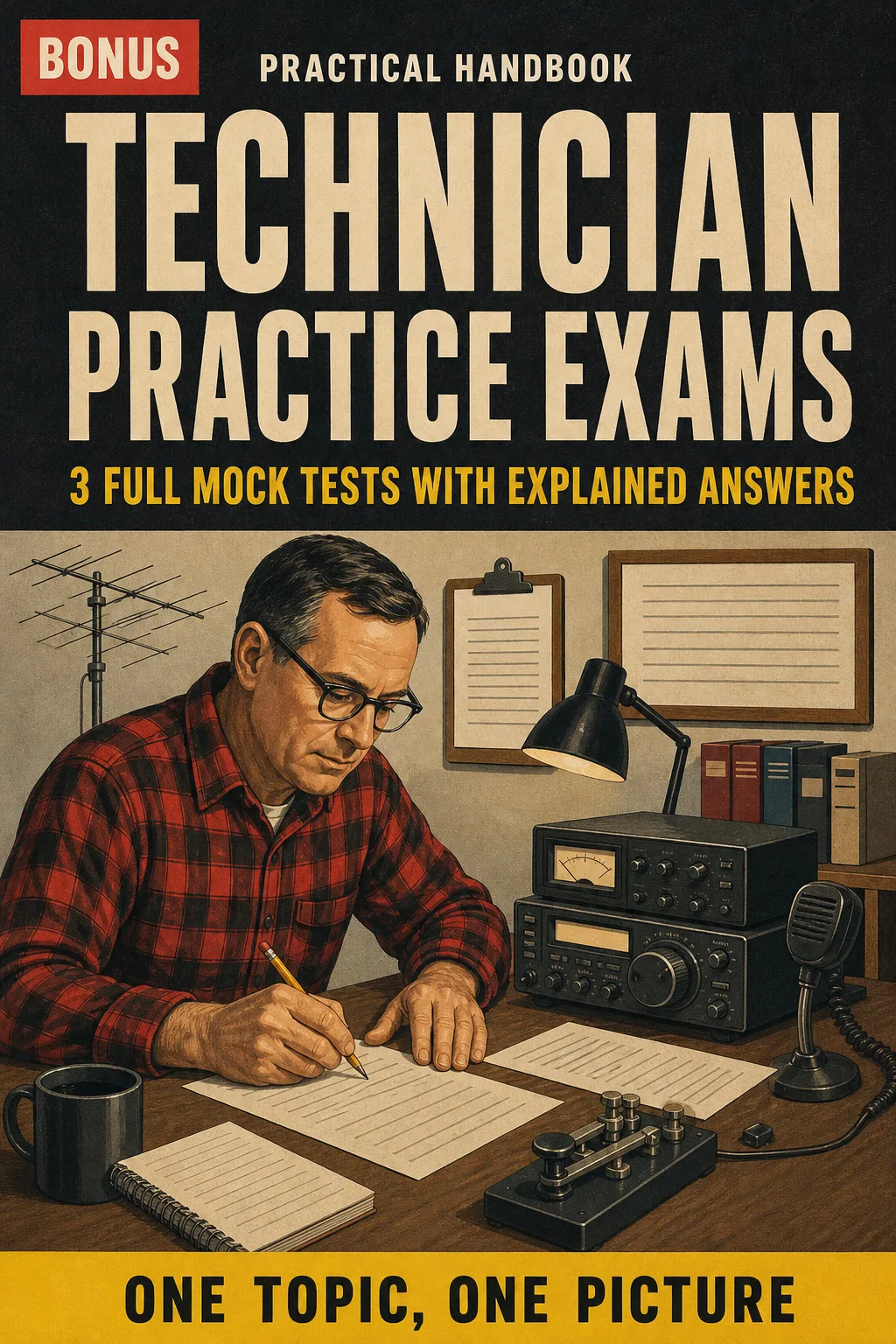
Technician Practice Exams: 3 Full Mock Tests with Explained Answers

BONUS 1: «Technician Practice Exams: 3 Full Mock Tests with Explained Answers»

Value on its own: US$ 17.90

Practice under real exam conditions, 35 questions at a time, and see in one line why each right answer is right.

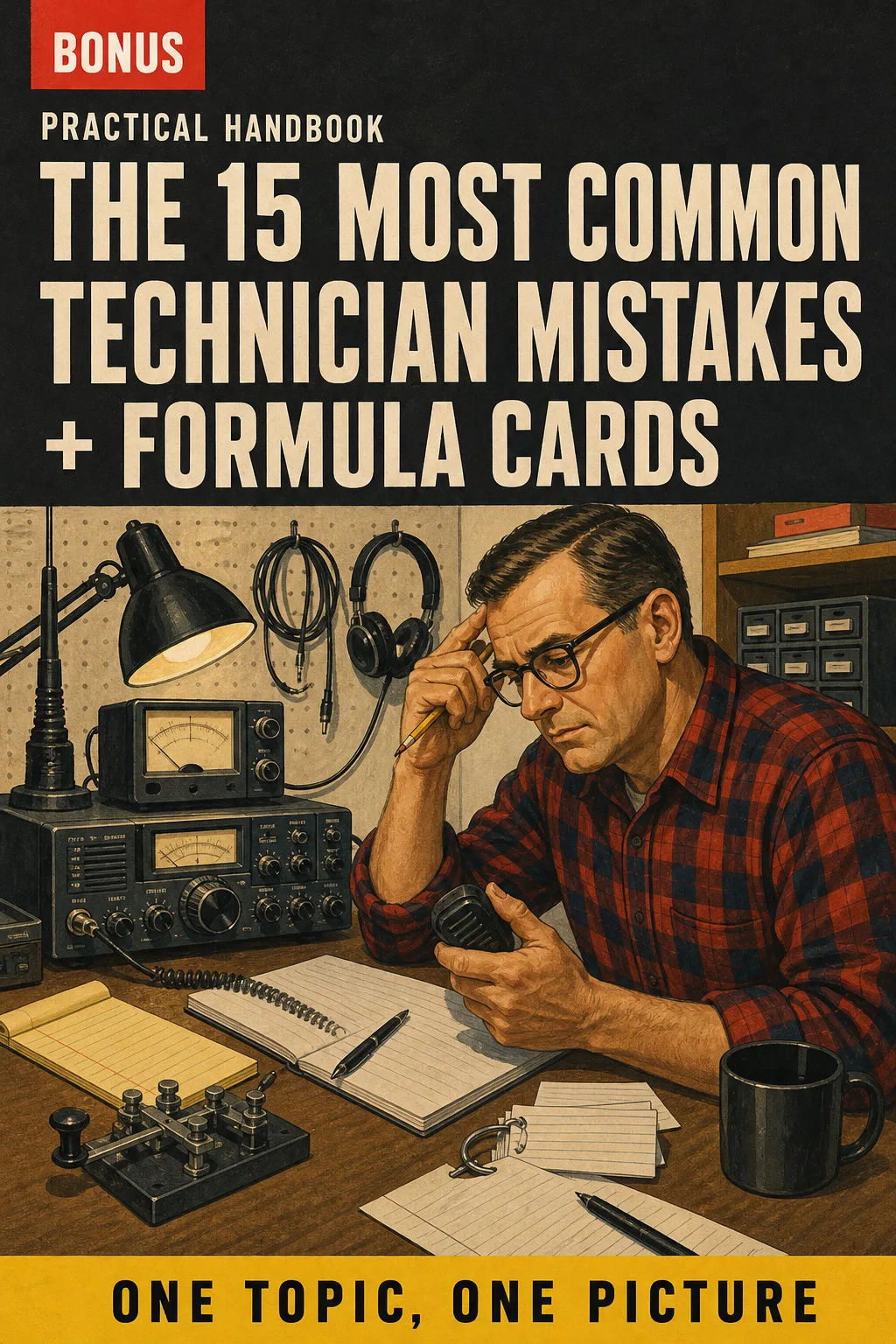
The 15 Most Common Technician Mistakes + Formula Cards

BONUS 2: «The 15 Most Common Technician Mistakes + Formula Cards»

Value on its own: US$ 14.90

Spot the mix-ups that trip people up most often (MHz vs. meters, offset vs. tone, watts vs. volts) and keep every formula on one printable card.

Ham Radio Technician Illustrated with 2 Free Books

  • Ham Radio Technician Illustrated: 65 illustrated pagesUS$ 63
  • BONUS 1: Technician Practice Exams: 3 Full Mock Tests with Explained AnswersUS$ 17.90
  • BONUS 2: The 15 Most Common Technician Mistakes + Formula CardsUS$ 14.90
  • High-resolution PDF to printIncluded
Total value US$ 95.80
YOUR PRICE:
US$ 27
You save US$ 68.80
YES, I WANT HAM RADIO TECHNICIAN ILLUSTRATED FOR US$ 27

📄 This is a digital PDF book sent to your email: nothing is printed or shipped.

Secure purchaseEncrypted payment30-day guarantee

PDF by email: We email you Ham Radio Technician Illustrated as a PDF, together with the two free books. It's a single payment: no installments, no extra charges.

Who This Book Is For

You're studying for the Technician

You're studying for the Technician

Instead of hundreds of scattered pool questions, you get the picture behind them: one topic per page, in a clear order.

Your exam session is coming up

Your exam session is coming up

You review band edges, Ohm's law and antenna lengths at a glance, and practice with 3 full mock tests.

You already have your call sign

You already have your call sign

You keep the repeater, offset and tone pages printed by the radio, so your first contacts go right.

Everything You Get Today

US$ 95.80US$ 27
YES, I WANT HAM RADIO TECHNICIAN ILLUSTRATED FOR US$ 27

📄 This is a digital PDF book sent to your email: nothing is printed or shipped.

30DAYS
GUARANTEE

30-Day Guarantee

Try Ham Radio Technician Illustrated for 30 days, bonus books included.

We refund everything if the file won't open, if the book isn't what you see here, if you were charged twice or if the email doesn't arrive. Just email us.

You pay once. No subscriptions.

Frequently Asked Questions

Is it for me if I haven't touched a formula since high school?

Yes. The math is Ohm's law, power and wavelength, each drawn with a worked example in volts, amps, ohms, MHz and meters.

Where does the content come from?

It's written from the FCC amateur radio rules (47 CFR Part 97) and the 2026-2030 Technician (Element 2) question pool published by the NCVEC Question Pool Committee: the pool used at exam sessions from July 1, 2026 to June 30, 2030.

Is this official material?

No. It's an independent illustrated study book. It isn't issued, approved or endorsed by the FCC, the ARRL or any VEC.

Does it replace a licensing class or a free pool app?

No, use it alongside them. A pool app drills the questions; this book draws the idea behind them. When a question about MHz, Ohm's law or the dipole is worded differently, you still know the answer, because you saw the drawing, not just the answer letter.

Are the practice questions the real exam questions?

No. The practice questions are written for this book. They cover the same topics but are not official exam questions.

When and how do I get it?

The book and the 2 bonus books arrive as PDFs by email, at the address you enter at checkout.

Do I have to pay every month?

No. It's a one-time payment. No subscription.

Can I have it on paper?

Yes. It's a PDF you can print at home or at a print shop and keep on your workbench.

How does the refund work?

You have 30 days. We refund everything if the file won't open, if the book isn't what you see on this page, if you were charged twice or if the email doesn't arrive: just email us.

Before You Close This Page

No more rereading with nothing sticking.

The band chart, Ohm's law and the dipole: you see them drawn, and that's it.

You walk into the exam session knowing where everything is.

Drawings make studying faster.

The book is right below.

One-time payment: US$ 27 · Guarantee: 30 days · PDF by email

YES, I WANT HAM RADIO TECHNICIAN ILLUSTRATED FOR US$ 27

📄 This is a digital PDF book sent to your email: nothing is printed or shipped.